‘Adversity leads to opportunity’
Synopsis
To begin to understand who Doug Kuntz was, let’s turn back the clock about 60 years.
He and his mom were heading home from the Elks Country Club in Lafayette, Indiana, when the then-teenager asked why his mom golfed with a group of ladies who were – as he put it – “no good.”
“Son, if you can’t say something nice about someone, you probably shouldn’t say anything at all,” his mom told him.
“Secondly, lots of ladies just need a positive thought and an optimistic way of playing the game.
“And last but not least, Doug, we were put on this earth to take care of other people.”
Important life lessons. Ones that Kuntz took to heart and became foundational to his more than 30 years as a golf professional at Richmond Elks Country Club.
Kuntz was known to share a little wisdom of his own with those he worked and played alongside, especially the junior golfers who came through the Elks over the years:
“Get up, dress up, show up.”
“A path with no obstacles probably leads to nowhere.”
“We all have a persistent attribute, find it and be optimistic!”
But it was another of his favorite sayings that would take center stage over the final years of his life: “Adversity leads to opportunity.”
On Feb. 3, 2009 – just a month after his 50th birthday – Kuntz learned he had Parkinson’s disease.
A neurological disorder, Parkinson’s typically is diagnosed after age 60. Only about 100,000 people – or some 4% of all cases in the U.S. – live with the young-onset version of the disease.
Parkinson’s is a progressive disorder affecting the dopamine-producing cells in our bodies that help regulate movement, mood, and motivation. When most people envision the disease, they often think about the tremors or shaking that’s impacted celebrities such as Michael J. Fox and Muhammad Ali.
But that’s not necessarily the case for everyone who finds themself fighting Parkinson’s. For Kuntz, the first sign came two years before his diagnosis.
The chairman of the local Elks board at the time asked Kuntz why he kept holding up his left arm near his waist. Neither Kuntz nor his wife, Marianne, had noticed the odd behavior until that point.
“We spent a year going from place to place trying to find out what was going on,” Marianne said. “He never shook, but he favored his left side. At first, they didn’t look at Parkinson’s as a possibility because he was so young.”
A second opinion at the University of Kentucky Neurology Center confirmed the diagnosis.
“At that moment, I thought my life was turned upside down,” Kuntz wrote in “The Front Nine,” a book documenting his early years with the disease. “As it turned out, Parkinson’s has actually turned my life right side up.
“This may sound crazy, but being diagnosed with Parkinson’s made me realize how blessed I am. Through this adversity, I have been given the opportunity to help others who have Parkinson’s just like me.”
Zack Palmer is the current golf pro at the Elks and Kuntz’s chosen successor. The two had started working together when Palmer was in the eighth grade, one of many junior golfers Kuntz had greatly influenced.
“When people get a serious diagnosis like this, they often think, ‘Why me?’ or just sit around and do nothing,” Palmer said. “Doug’s mindset was I want to go do something about it and not just sit here and let it defeat me.
“He knew how to raise money using the golf course. That’s what he was best at, so that’s what he took advantage of.”
With the help of others, Kuntz started the annual Pro’s Players FORE Parkinson’s golf tournament at the Elks. The first event was held in 2011, raising $60,000 that was split in equal shares and given to the Michael J. Fox Foundation and the University of Kentucky Neurology Center, where Kuntz continued to receive care.
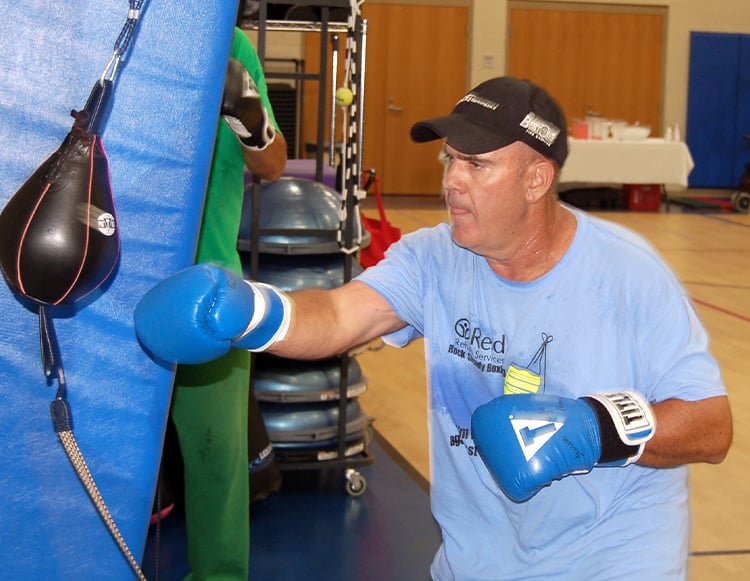
The next year, Reid Health came on as a title sponsor, and the proceeds were split between UK and the Reid Health Foundation to help Reid establish a new program aimed at those fighting against Parkinson’s, Rock Steady Boxing.
A non-contact rehabilitation class, Rock Steady Boxing helps to slow the progression of the disease through exercise. In 2013, Reid became the first hospital affiliate of the program.
Kuntz was among the first participants in the local class and continued to attend for several years until his disease progressed to the point where he struggled to stand.
“I think being part of Rock Steady gave him at least a couple more years in his professional working career,” Palmer said.
“It helped Doug tremendously for years,” Marianne said. “Being in the class, you see you’re not alone. You can go and not only fight against the disease that’s attacking your body, but you have friends there you can talk to.”
The money raised by the Pro’s Players FORE Parkinson’s event has grown over the years, culminating in a record $100,000 last year and putting a milestone in sight for this year – $1 million raised in total over 15 years.
“It’s going to be awesome once we hit that million-dollar mark and you just sit back and say, ‘Wow, it’s pretty amazing how a group of people can come together and do something like this,’” Palmer said.
“By the end of it, you’re tired and worn out, but it’s well worth the reward. I’ve been to the classes out at Reid and seen it firsthand. Man, it makes a really big difference.”
For Kuntz, the joy of putting on the tournament each year came not only from knowing the impact of the money being raised but in getting to see so many of the people he had come to know and love over his career.
“He was moved every year, when all those people would come. He would be without words,” Marianne said.
“Doug saw some of his former employees and all the kids that went through high school golf coming back to play, and he was astounded by the response. It’s just snowballed.”
In recognition of everything Kuntz has done to bring more awareness of Parkinson’s and to support Rock Steady Boxing, Reid Health is naming a space in the Reid Neurology Associates practice on the health system’s main campus The Doug Kuntz Neuroscience Center.
“This space will recognize and celebrate Doug’s legacy to fight this disease and lift up others along the way. Doug is one of the most remarkable people I’ve ever met. Many people strive to have one legacy in life. Doug has multiple, and his impact on Reid and on the community is one to celebrate,” said Jason Troutwine, Vice President/Foundation President, Reid Health.
Kuntz – who died in December 2024, a month short of his 66th birthday – wasn’t one who sought attention, keeping his name off the tournament he started. But that doesn’t mean he wouldn’t have been overjoyed in having a space at Reid bear his name.
“When I found out about the naming, it blew me away. Doug would be so proud,” Marianne said.
“When you see Pro’s Players FORE Parkinson’s – when you see that logo or you hear someone talk about it – instantly you think of Doug Kuntz,” Palmer said. “That’s legacy right there.
“I think Doug’s smiling down now.”
In his book, Kuntz had one more piece of advice to share with those who found themselves fighting the same battle as him.
“To those who suffer from Parkinson’s like me, we are not alone,” he wrote. “Be proactive! Partner with a doctor you like, participate in research, exercise, and challenge yourself with activities you enjoy.
“Turn your adversity into an opportunity. Now is the time to listen to others who have adversity in their own life and help them be optimistic.”
Reid’s Rock Steady Boxing program is also funded in part by a community grant from the Parkinson's Foundation. Classes are available in Richmond and Connersville. For more information, call (765) 935-8570 or visit reidhealth.org/rock.