From paralysis to progress: Alysa Collins’ CIDP Journey
Synopsis
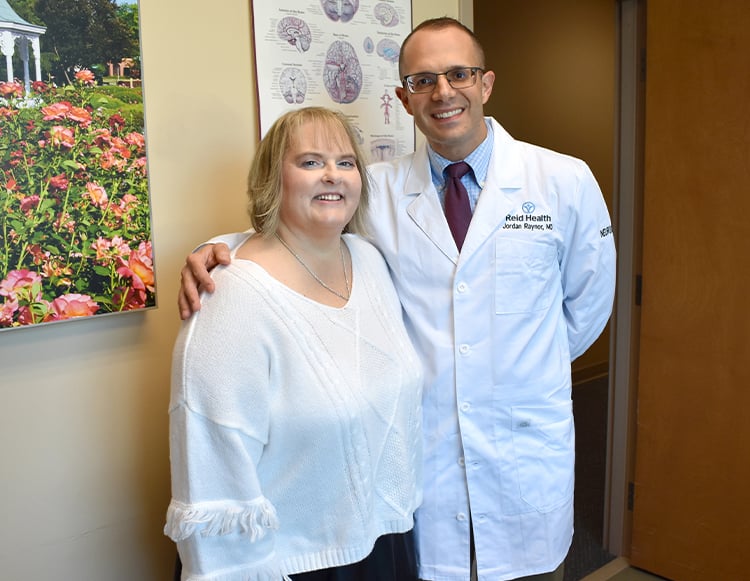
Alysa Collins is reclaiming her life years after a rare condition left her immobile and in severe pain.
The symptoms started slowly. Normally a quick thinker and a multitasker, Collins was having issues with brain fog. She didn’t realize it at the time, but it was an early sign something was wrong.
“Looking back, that was one of the first symptoms,” Collins said.
Then she noticed a tingling sensation in her right leg. Eventually, the tingling was accompanied by severe pain and increasing weakness.
The pain grew so bad it delayed her commute from work in Dayton to her home in New Madison, Ohio. If the side of Collins’ leg touched the seat, she would have to pull over to take a break and unfasten her seatbelt so she could cope enough to drive the rest of the way, she said.
As a diabetic, Collins thought the tingling and pain could be a sign of neuropathy. She consulted with her family doctor about her diabetes, its possible effects, and if an allergic reaction to her insulin could potentially be the cause. None of those possibilities turned out to be the answer. Instead, her symptoms and pain continued to increase.
“It was just getting worse. It got to the point where I was falling all the time,” Collins said.
Arthritis was also considered. X-rays and CT scans didn’t find a cause either.
“We just weren’t getting any answers,” Collins said.
The pain, weakness, and immobility in her legs continued to worsen.
A co-worker had a suggestion. His wife had multiple sclerosis (MS), and he thought some of their symptoms sounded similar. A neurologist had been able to help, so the co-worker recommended Collins check into whether the same could be done for her.
“At the time, it was affecting my work and I was in so much pain I couldn’t even function, so I said OK. I was open to suggestions,” Collins said.
She called Reid Neurology Associates and explained her situation. After initial visits and consultations, Collins was paired with Jordan Raynor, MD.
Raynor had learned about a condition called Chronic Inflammatory Demyelinating Polyneuropathy (CIDP) training under John C. Kincaid, MD, at Indiana University Medical Center.
CIDP is a rare neurological disorder with progressive weakness and reduced feeling in the arms and legs because of damage to the myelin sheath, the fat-based covering that protects nerves.
Raynor believed CIDP’s symptoms lined up with what Collins was experiencing and ordered a test to check her spinal fluid. At the time, only about 40,000 people in the world had been diagnosed with CIDP. The more that’s learned about the condition, the more doctors can diagnose and treat it.
CIDP was impacting Collins’ life at work and at home. She suffered from constant pain, lost more mobility each day, and became more reliant on family members for care.
“It was getting worse. I couldn’t lift my feet. I was falling all the time. It got to the point where I couldn’t work,” she said.
When CIDP left her paralyzed from the waist down, Collins retired as a customer support specialist for AT&T. Her husband, Jeff, gave up his job to care for her and drive her to appointments. Her son, Chase, also took care of her.
“They carried me around. They would help me up or push my wheelchair,” she said.
After her diagnosis, treatment began, and Dr. Raynor exceeded her expectations. One of the options included a port for plasma treatment, but because of a previous heart attack, Collins was uncomfortable with that option and explained her reasoning to Dr. Raynor.
“He found an alternative, and I didn’t have to do the port. To me, that meant the world,” she said.
Dr. Raynor also helped Collins regain her independence and state of mind. Following her diagnosis, she had several concerns with her quality of life, depression, and self-esteem.
“I felt so alone because I didn’t know anyone else who had CIDP,” Collins said.
Again, Dr. Raynor had a solution. The Ohio State University was hosting a conference he recommended she attend to meet others with her condition. For the first time, she could interact with people who knew firsthand what she was going through.
She could learn more from her peers, and she felt a connection to those who have had the same experiences. She extended her community by joining an online group, too.
In caring for the whole person – body, mind, and spirit – Collins’ treatment plan included occupational and physical therapy with Reid’s Rehabilitation Services. The therapies helped her to adjust to her condition and to regain use of her legs.
Collins said the Rehabilitation care team had a positive impact on her mental health, too. A therapist recommended aquatic therapy after Collins mentioned how much she liked being in the water.
“During aquatic therapy, you become buoyant, and you have your legs back again. That’s an experience,” Collins said. “I cried.”
“It’s so amazing to use my legs and have this feeling, to be in the water and to feel my legs on my own. It did a lot for my mental health because it made me feel normal again. It was a big deal for me.”
Collins said the Rehabilitation team members were awesome, encouraging, and knew when to maximize efforts.
“They push you to do as much as you can but never push you too much. Sometimes you just don’t know where the line is to overdo it. They know,” Collins said.
She now does physical therapy on her own at home. Each day, she continues to grow stronger.
“No cure exists for this condition, but we’ve gotten Alysa to the point where she is ambulatory again,” Raynor said.
As Collins is regaining her mobility, she’s increasingly becoming more active and more self-sufficient. In June, she went to an outdoor concert to see Fallout Boy with her son. She uses a walker instead of her wheelchair. She has goals to walk independently for brief amounts of time. Also, she would like to drive again one day.
“I’m not the same as I was, but I have come a long, long way,” Collins said. “I was ready to give up. Dr. Raynor saved my life.”