Every second counts: Parental instincts and pediatric readiness save newborn
Synopsis
When newborn Kolson Brown suddenly stopped breathing, his parents’ quick instincts and a pediatric-ready emergency team at Reid Health saved his life.
In the early morning hours in late January, Brice and Grace Brown faced every parent’s worst fear: their infant son was in critical distress. Thanks to their fast action — and the specialized pediatric ready care team at Reid — Kolson is thriving today.
Infants and children in emergencies need more than medical attention. They require specially trained providers, child-sized equipment, and age-appropriate medications. In those moments, every second counts — and a pediatric-certified Emergency Services department can mean everything. By this time in January, Reid had earned a Pediatric Readiness Certification, a national benchmark for hospitals equipped to care for children with expert, around-the-clock care.
At Reid, the Browns were met by Emily Kraft, MD, EMS Medical Director for Reid, who immediately recognized the severity of Kolson’s condition. Just days before, they'd visited the emergency room, but this time it was different.
Dr. Kraft and her team stabilized Kolson and arranged for critical transport to Indianapolis. They didn’t just care for Kolson — they supported Brice and Grace, offering a place to rest, food, and reassurance amid the chaos.
Kolson is a fighter.
While his story includes terrifying moments, it also highlights the importance of preparation and partnership. Nearly a year later, Kolson is thriving as his parents, along with grandparents Kay and Tim Brown, share their experience in the hope it empowers others to trust their instincts, ask questions, and seek help when something feels off.
The beginning
Kolson was born early at 35 weeks at St. Vincent’s. Grace said his delivery came with complications for herself, but he initially seemed fine.
“As soon as he was born, he laid on my chest for maybe five minutes,” Grace said. “Then he started struggling to breathe. We told them to take him to the NICU. We were there for five days.”
After doing well, he was discharged and went home with his parents to Richmond to meet his two siblings, then ages 2 and 3.
Within a week, Kolson developed RSV. They took him to see his pediatrician and were told what symptoms to watch for like chest retractions, short, shallow, or rapid breathing, lethargy, or feeding changes. That night, Kolson’s symptoms worsened. They took him to Reid and then to Saint Vincent’s in Indianapolis. While there he didn’t require oxygen.
“He did great all day, so they sent us home with more of what to look for like the retractions, nasal flaring, and the hoarse breathing sounds,” Brice said.
Two days later, Kolson was at home. His parents said that’s when he started having brief pauses in his breathing. His color changed slightly to almost a blue tone, his parents said, but when they roused him, he seemed normal and sounded fine when he cried.
Around midnight, an Owlet sock they had on Kolson’s foot to monitor his vital signs showed that his oxygen saturation levels were fluctuating in the mid-80s, but they weren't sure about its accuracy. The American Academy of Pediatrics (AAP) recommends a healthy, full-term infant’s oxygen levels be 95-100% and preterm infant’s levels above 90%. They checked that the sock was tight on his foot, adjusted it, and that Kolson's skin tone looked like it should.
Still, Brice and Grace decided to take turns staying awake.
Critical moments
Grace went to sleep around 2 a.m. while Brice monitored Kolson and the Owlet sock, which continued to fluctuate from the mid-80s to 90s. Everything changed at 4:30 a.m. when the Owlet alarms were sounding continuously as oxygen levels dropped into the 70s.
“We tried to wake him, make him cry, checked the sock, made sure it was tight,” Brice said.
They debated driving to the ER themselves but decided to call for an ambulance. Brice also called his mother, Kay, to watch their toddlers so they could go with Kolson to the hospital.
“He was very pale,” Brice said. “He wasn’t responding.”
Brice said the dispatcher asked if Kolson’s breathing sounded agonal — an abnormal, gasping pattern. To him, it didn’t.
“It sounded like a newborn’s hoarse breathing,” he said.
Though CPR-trained for adults, Brice hesitated to begin compressions since Kolson still had a strong pulse.
As emergency lights approached, Brice’s mother, Kay, a former certified EMT, arrived first. She had called on her way and asked about Kolson’s Owlet readings.
“He said it was 59,” she said.
When she walked in, Kolson was limp in their arms.
“I didn’t hesitate,” she said. “I just took him and started a sternal rub and pinched him to get a response.”
He gave a faint whimper. It was just enough.
When the ambulance arrived, Kay handed Kolson to the medics. Grace rode with him to Reid while Brice followed. His oxygen levels improved enroute, Grace said.
At Reid’s ER, Grace stayed by Kolson’s side with the EMT crew.
“She talked with Dr. Kraft and all the other countless people in the room about what was going on,” Brice said. “Then time just seemed to crawl. I have no idea how long it was before decisions were made and actions taken.”
Kay had messaged her husband, Tim — who was just starting his shift with Reid’s EMS team — that Kolson’s oxygen levels looked OK and he could go on to work. But Tim had already arrived at the ER, and the situation was changing.
Dr. Kraft said it was within the first few minutes that everything started to quickly change for Kolson.
“He didn't look great, but it wasn't quite at that emergency level yet, so we were getting a lot of things going. It was within those first few minutes that he had another apneic episode where he wasn't breathing,” she said.
That episode triggered a drop in Kolson’s oxygen saturation, prompting the ER team to shift from a calm pace to a much more urgent one, Dr. Kraft said.
She then went to update Brice and Grace.
A setback
Dr. Kraft let Brice and Grace know Kolson was struggling and needed to be intubated to help him breathe.
“She asked us to follow a nurse to the consultation room,” Brice said. “It felt like eternity in there.”
While they waited a Richmond Fire Department medic stopped by to check in on them, and one of Reid’s respiratory therapists gave them reassurance they had taken the right steps to bring him in — and that choosing to stay awake to watch over Kolson made a difference. She also escorted them to Kolson’s room.
“It was a different type of feeling, going back there and seeing him like that,” Grace said.
They learned Lifeline was on its way to fly him to Indianapolis for specialized care.
The flight team had delays, but once they arrived, introductions were made and they updated the family on what would happen before and during transport to Peyton Manning Children’s Hospital in Indianapolis.
They continued to be at Kolson’s side, talking to him and holding his hand, while getting updates from the medical staff as they were checking on him, preparing him for boarding, and switching him over to their system.
“He was struggling all together and he looked terrible,” Brice said. “We were watching the monitors and it kept dropping. And then the flight nurse said she wasn’t getting breathing sounds.”
Their world stopped.
Brice and Grace were ushered out of the room so the medical staff could quickly work on Kolson to restart his breathing. Once out of the room, Brice watched as the team worked.
“I could see the defibrillator; it stayed off the whole time. Thank God. I would’ve lost it,” he said.
“It felt like hours. Then everything just stopped. The doors opened, and everyone walked out.”
The team discovered Kolson’s breathing tube had clogged, and he needed to be reintubated before he could be safely flown to Indianapolis.
Once he was stabilized, Kolson was carefully moved into an incubator and taken to the helipad.
Recovery and diagnosis
They watched as Kolson was loaded into the incubator and taken to the helipad. Then they waited for the takeoff.
“We just stood there. There were so many emotions,” Grace said.
After takeoff, Brice and Grace planned to grab caffeine and food before making the 80-mile drive to Indianapolis.
Dr. Kraft was already there waiting with snacks and drinks for the couple.
“She asked who was driving us over and I said I was,” Brice said.
Dr. Kraft asked when he’d last eaten or slept and that he shouldn't be driving, but she also understood and as a parent herself admitted she would’ve done the same, he said.
Once in Indianapolis, Kolson spent nine days in the Pediatric Intensive Care Unit (PICU) before returning home. Kolson was on a ventilator for nearly five days before transitioning to high-flow oxygen. That’s when they discovered a congenital heart defect: a Ventricular Septal Defect (VSD). If not for the hospitalization, it might not have been detected.
At Reid and Peyton Manning, the Browns were grateful for the care Kolson received and the coordination among the teams.
Brice shared their story on social media to help other parents and encourage them to take proactive measures. He also noted a difference in preparation and care between their first and second ER visits, crediting Reid’s Pediatric Readiness Certification.
During his hospital stay, Kolson was found to have a notched vocal cord, likely from the reintubation.
Dr. Kraft explained that when Kolson was born, respiratory illnesses were more cases of respiratory illness than usual. He had contracted RSV, which weakened his immune system and allowed bacteria — normally found in the gut — to spread and cause a serious infection called sepsis. As a newborn who had spent time in the NICU and needed support to breathe, Kolson was already at high risk.
“Newborn sepsis is a whole other challenge on top of everything else he was already facing,” Dr. Kraft said. “He was hit with a double whammy — RSV and then the bacterial infection.”
A respiratory therapist later confirmed their instincts were right: “If you’d gone to sleep, the outcome could have been very different.”
Grace said they were cautious when bringing Kolson home, limiting visitors and keeping his siblings at a distance. Having gone through a premature birth with their second child, they were experienced. They also knew the signs of RSV and took extra precautions.
Dr. Kraft credited Grace and Brice that following their intuition was the right thing to do.
“You did a really good job of recognizing that something was different,” she said.
“I always tell parents that you know your children best, so when you see something that isn't right, go with your gut intuition. You were on it every single time to recognize something's not right and that you needed to take that next step.”
Moving forward
Their ability to trust their instincts, ask questions, and act when something didn’t feel right became the foundation that carried them through Kolson’s hospital stay.
Kolson spent 19 of his first 31 days in the hospital, his parents said.
They had help from the Owlet — but it was their reliance on each other that got them through the emergency and the stressful days following.
“This brought us closer as parents and as a couple,” Grace said.
They also had a community of support.
They also stayed calm.
“Stay calm, lean on your support system. Having people around you — especially those you trust — helps you make better decisions,” Brice said.
Dr. Kraft said she repeatedly told Grace and Brice how impressed she was by their calmness.
“You had the most amazing level of calm, considering everything that was going on and how scary of a situation it was and that makes a difference because your level of calm allows us to be able to focus on what's going on and be able to communicate that with you,” Dr. Kraft said.
Tim also offers simple advice to remember based on his years of experience as a firefighter, an EMT, and as a parent.
“If you don’t know, it’s time to go,” he said.
Kay said it’s important to keep asking questions until you understand.
“Advocate, always advocate for your child,” she said.
Kolson is stronger months later.
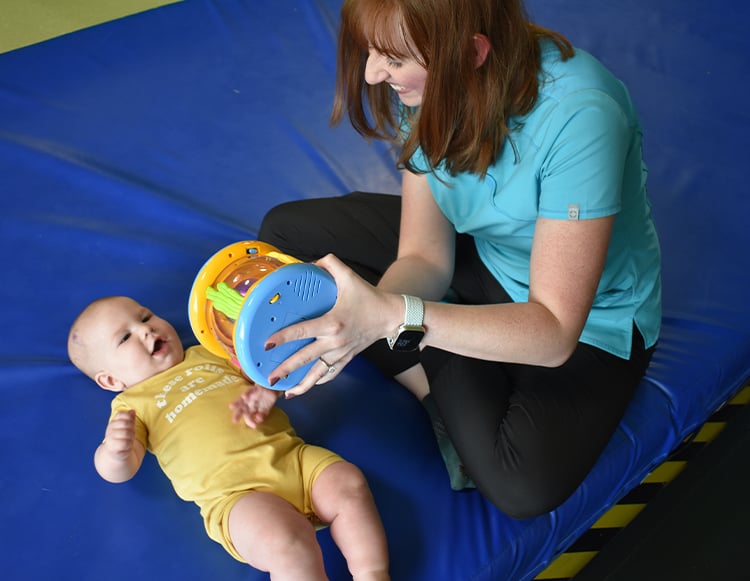
Today, Reid Pediatric Therapy is working with Kolson with Physical Therapy, Occupational Therapy and Speech Therapy to support his development in his first year including helping with eating and drinking, vocal cords, strengthening his lungs, and now as he advances, his core muscle groups to sit up on his own and crawl.
Every milestone is a celebration.
Kolson’s thriving because his family trusted their instincts, asked the right questions, and acted without delay. Their story’s a powerful reminder for caregivers that when something feels off, don’t wait.
Speak up, seek help, and never underestimate the power of your intuition.
About Pediatric Readiness
Reid Health has been designated a Pediatric Ready Level Facility by the Indiana Emergency Medical Services for Children (IEMSC), recognizing its ability to handle pediatric emergencies with expert care.
This four-year designation, based on the National Pediatric Readiness Project (NPRP) Assessment, requires hospitals to maintain specialized pediatric equipment, supplies, medications, and staff training, along with specific policies tailored to children's unique needs.
Reid scored over 95 on the NPRP scale, well above the 88-benchmark linked to significantly improved outcomes for ill and injured children. The designation followed a multi-year process, including a site visit completed in September and certification awarded in January 2025.
Reid EMS ambulances are equipped for pediatric emergencies, including specially prepared bags to quickly provide care for children, and EMS staff have been trained on neo-natal resuscitation. Additionally, Reid's Emergency Department is also certified as a Level III Trauma Center and a Primary Stroke Center.