Excisions of skin lesions
Reid Health offers advanced surgical excisions of skin lesions to help remove areas of concern and help you continue your path to treatment.
Surgical treatment of skin issues
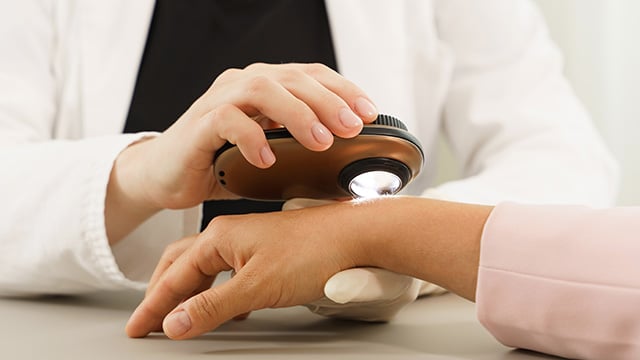
Excisions of skin lesions are medical procedures where providers remove abnormal growths from the skin. These could be bumps, cysts, moles, skin cancer, sores, warts, or any other growth. By cutting out the affected area and some surrounding tissue, providers can not only evaluate the growth and determine if it’s a cause for concern but also stop some dangerous growths — such as cancer — from spreading.
The skin lesion excision options at Reid Health can help people in East Central Indiana and West Central Ohio make better decisions and stay informed about skin health.
In-office lesion removal
Not all skin lesion removal requires a trip to the operating room. In most cases, skin lesion removal is performed in your provider’s office.
For most in-office removals, your skin will be numbed with a local anesthetic that is either injected into the surrounding skin or used topically — either sprayed or rubbed on as a cream. You should not feel significant pain during the procedures.
Surgical Services
Pediatric skin lesion excision
Excisions of skin lesions aren’t only performed on adults. Our providers offer skin lesion excisions for people of all ages in East Central Indiana and West Central Ohio.
Children might need removal of many types of bumps, moles, spots, or other growths, including birthmarks, cysts, hemangiomas, warts, skin tags, and more. Our teams know that kids need special care and have the expertise necessary to care for their delicate skin.
Types of skin lesion removal
The method your provider uses to remove the lesion varies depending on its size, type, and location. Once your lesion is removed, your provider will likely send it to a lab to be examined.
The types of lesion removal available at Reid include:
- Cryotherapy: Your provider might recommend cryotherapy for certain skin issues like warts, bumps caused by the overgrowth of a protein called keratin, a skin infection called molluscum contagiosum, or some types of skin cancer. During cryotherapy, the tissue is frozen with liquid nitrogen that is either applied with a cotton swab, sprayed, or deployed with a probe. After your cryotherapy is performed, the area will usually blister and the treated area will peel off.
- Laser excision: Your provider will use a light beam called a laser to heat and destroy cells in the area of concern. Laser excision is an option for hair, moles, sunspots, tattoos, visible blood vessels, warts, and skin lesions that are either precancerous or noncancerous.
- Scissor excision: This type of excision is also used for lesions that affect the top layer of skin or extend above the skin. After your skin is numb, your provider will use a tool to lift and hold the skin lesion. Using curved scissors, they will cut around and under the area of concern. You will not need stitches in most cases, as medication will stop the bleeding.
- Shave excision: If your skin lesion affects the top layer of skin or extends above the skin, your provider might remove it with a shave excision. Your provider will numb the area and then use a small blade to shave off either part or all the lesion. Medicine will be applied to the area to stop any bleeding, and you can return home. You usually don’t need stitches for a shave excision.
- Skin excision (full): If your provider is concerned the skin lesion could be cancerous, they might perform a full skin excision. This type of surgical removal is used when the lesion is deeper in the skin. This procedure involves removing the entire lesion down to the fatty tissue under the skin. In most cases, the provider will also remove several millimeters around the area to ensure the whole lesion is gone. This type of excision usually requires stitches.
Surgical skin cancer excision
Surgery is a common treatment for many forms of skin cancer. In many cases, the tumor and surrounding skin are removed.
Your provider will use the stage and type of your skin cancer as well as the location of the growth to determine the most appropriate treatment.
Your skin cancer might be removed in the provider’s office with a minor skin excision. In some cases, however, treating skin cancer could require more involved surgery that should be performed in the hospital in an operating room.
Mohs micrographic surgery
During Mohs micrographic surgery, providers remove the tumor layer by layer, preserving healthy skin as much as possible. Mohs surgery is often performed in the provider’s office during one or two visits. It’s a preferred option when the skin cancer is in an area like the face, feet, genitalia, hands, nails, neck, or scalp or in any area where a provider wants to remove as little skin as possible.
For Mohs surgery, the provider numbs your skin before removing the visible part of the tumor and a few millimeters around it. Then, using a microscope, the provider examines the tissue for cancer. If no cancer is found, the surgery is done.
If cancer is found in the tissue, the provider returns to the patient and removes another layer of tissue, which is then evaluated under a microscope. If cancer is still found, the process is repeated until no cancer cells are present.
Each round of Mohs surgery takes about 20 minutes, and preparing the tissue and evaluating it with the microscope can take between 40 and 50 minutes.
After your skin cancer is completely removed, you might need stitches to stop bleeding. You won’t need stitches for some small wounds.
Mohs has a skin cancer cure rate of 99%.
Surgical services
Getting ready for surgery
Proper preparation is a critical part of the surgical process. By following your care team’s guidelines, you can help ensure a safer and smoother experience. Find out what you need to do before surgery.