Pediatric Feeding and Swallowing Program
For children with difficulty feeding or swallowing (also called dysphagia), trying to eat or drink safely can be a challenge. Our Pediatric Feeding and Swallowing Program can help.
Feeding and swallowing care close to home
Children of all ages may be affected by a feeding or swallowing problem. Our pediatric therapy team understands that this is a scary and overwhelming experience for both you and your child. We are here to help you through this challenging time.
Rather than letting you face your child’s swallowing disorder alone, the Pediatric Feeding and Swallowing Program at Reid Health helps families living with the realities of dysphagia (and other feeding disorders) in East Central Indiana and West Central Ohio.
Our caring and highly trained occupational therapists (OTs) and pediatric speech-language pathologists (SLPs), offer both individual and group therapy sessions to help your child safely meet their nutritional needs and gain confidence in their feeding and swallowing abilities.
See how we can help your child thrive.
Who should consider feeding and swallowing therapy?
If your child has any of the following symptoms, speak with your pediatrician or primary care provider for a referral to occupational or speech therapy for assessment and recommendation for our Feeding and Swallowing Program.
Potential signs and symptoms of a feeding or swallowing difficulty include:
- Choking, coughing, or puking while eating
- Failing to meet growth milestone
- Food refusal (beyond picky eating)
- Inability to gain weight
- Previously used a feeding tube
- Frequent illnesses impacting the lungs from liquid going down the airway
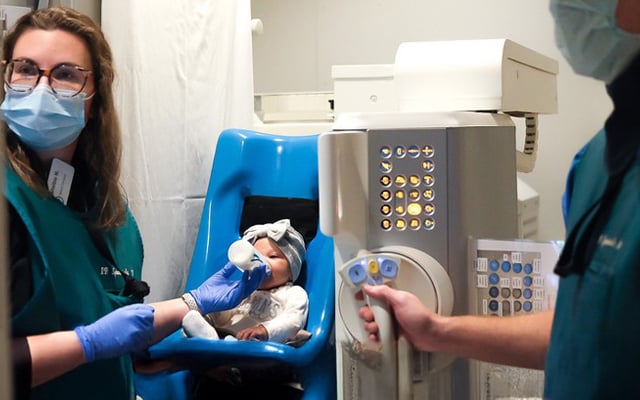
Diagnosing swallowing disorders
To check for dysphagia, your speech-language pathologist might suggest a Modified Barium Swallow Study (MBSS). During an MBSS, we use video X-ray and trace amounts of barium (or contrast agent) to see if food and drink is safely making it from your child’s mouth to the esophagus , or if it’s entering the airway (aspiration) impacting their lungs.
This noninvasive exam usually takes about 30 minutes — which varies based on patient need — and helps us understand the severity of your child’s swallowing disorder, so we can create the best treatment. When possible, you can stay in the room throughout the study, so you can help the SLP and radiologist with feeding as needed and see the results in real time.
Treatment plans tailored for your child
Feeding and swallowing difficulties can look different for every child, and that’s why our pediatric OTs and SLPs work with you and your family to create a treatment plan that suits your child’s unique needs. Whether that’s one-on-one therapy or in one of our feeding groups, together, we’ll find the best treatment options to help your child grow, thrive, and enjoy meals with their friends and loved ones.
Feeding and swallowing groups at Reid Health
Children benefit by participating in groups with peers their age. we offer feeding groups for kids living with dysphagia or other feeding disorders, broken out by age and ability.
In group therapy, your child and up to five new friends will work with an SLP and OT to learn strategies for improving feeding and swallowing using the Sequential-Oral-Sensory (SOS) Approach to Feeding. Meaning, that your child and their group mates are introduced to new foods in a safe, judgment-free environment. One that encourages play to explore all aspects of the feeding process.
Your child’s therapist(s) may recommend one of our feeding groups based on age and skill. We offer the following groups:
- Tater tots
- 2-3 years old
- Smaller groups for more individual attention
- Pretend play is used heavily
- Mighty munchers
- 3-6 years old
- Food is explored, deconstructed, and manipulated to increase familiarity and comfort
- Snack pack
- 5 and older
- Uses age-appropriate language to analyze and understand aspects of targeted food items
Speak with your child’s care team to see which feeding group is the best for their age and current abilities.