Angioplasty
The experienced team at Reid Health offers minimally invasive angioplasty to restore blood flow to blocked arteries, helping you find relief from heart concerns and vascular issues.
A surgery-free way to open blocked arteries
Narrowed and blocked arteries can cause symptoms like chest pain or shortness of breath and lead to serious issues, including heart attacks and strokes. An angioplasty procedure helps clear these blockages without the need for major surgery. At Reid Health Heart & Vascular Center, you’ll find exceptional care — close to home in East Central Indiana and West Central Ohio — from a team you know and trust.
Why choose Reid Health?
Your heart is in the right place
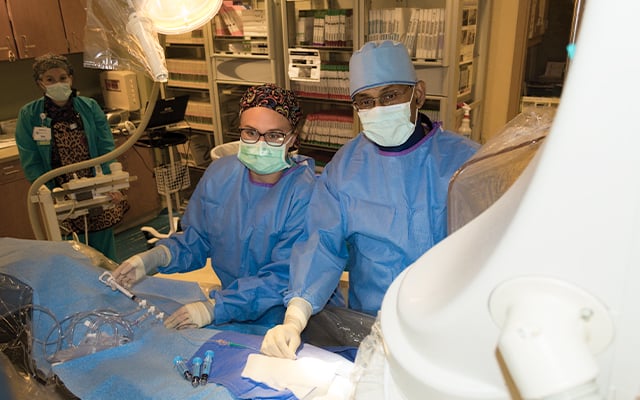
Our highly skilled interventional cardiologists and vascular surgeons use the latest imaging technology and advanced cardiac catheterization to treat a variety of issues related to blocked or narrowed arteries.
At Reid, you have access to:
- Board-certified heart and vascular specialists with years of experience in complex cases
- Coordination between primary and specialty care providers so nothing gets overlooked or missed
- Personalized attention you can only find from a team who knows your goals and priorities
- The convenience of care without the stress of a long commute
What is angioplasty?
An angioplasty is a procedure heart and vascular specialists use when plaque (a sticky buildup of cholesterol, calcium, and other materials) narrows or blocks your veins and arteries.
During an angioplasty, your provider guides a small balloon to the blocked part of your artery and then inflates it to push plaque out of the way and improve blood flow.
You might also need a stent, a small mesh tube that keeps the artery or vein open. Providers call this angioplasty and stenting.
When interventional cardiologists use angioplasty and stents to clear arteries in the heart, it’s called percutaneous coronary intervention. Vascular surgeons can also use angioplasty with or without a stent to treat health issues in areas outside the heart.
What's a difference between stent and angioplasty?
Both a stent and an angioplasty can help clear a blocked or narrowed artery. However, an angioplasty is performed first, followed by stent placement.
An angioplasty uses a balloon to open the artery. The stent stays behind and keeps the artery open long-term.
Many stents are coated with medicine to prevent blood clots and help stop the artery from narrowing later.
Conditions treated with Angioplasty
We use angioplasty to treat several conditions affecting your circulatory system, some of which include:
- Atherosclerosis: This is the medical term for plaque building up on artery walls. It causes artery walls to harden and can lead to coronary artery disease and many other heart issues.
- Coronary artery disease: This occurs when the arteries providing blood to the heart become blocked or narrowed. It can lead to a heart attack.
- Carotid artery disease: Similar to coronary artery disease, this condition affects arteries in the neck that carry blood to the brain. It can lead to a stroke.
- Heart attacks: Heart attacks occur when a coronary artery is completely blocked. An emergency angioplasty can quickly open the blocked artery.
- Peripheral artery disease (PAD): This is when blood vessels in the legs or arms narrow.
What to expect if you're having angioplasty?
Your angioplasty will take place in our catheterization lab, which earned American College of Cardiology accreditation for safety and quality. The procedure is common and doesn’t require a large incision.
An angioplasty usually follows these steps:
- You’ll receive medicine to help you relax (a sedative). Most people stay awake during the procedure, but some need general anesthesia.
- A nurse sterilizes and numbs the area where your provider inserts the catheter (likely an arm or leg).
- Your provider makes a small incision and inserts a catheter (small tube) with a balloon on the tip into the blood vessel. They use X-rays and a special contrast dye to find the exact location of the blockage.
- The provider inflates the balloon and might place a stent.
- The catheter is removed, and your incision is covered.
Angioplasties are generally not painful, but you could have some bruising or soreness where your provider inserted the catheter. You’ll likely need to rest for a short time and avoid heavy lifting or other intense activities for at least a day. Your doctor will give you other instructions for the hours and days after your procedure.
Do you go home the same day after angioplasty?
Often, people can go home the same day as an angioplasty. If your procedure was complicated, you might need to stay overnight. Having an angioplasty or a heart attack typically
requires staying in the hospital for longer than one day.
Frequently asked questions
How many hours does angioplasty take?
The length of an angioplasty varies based on the type you’re having and your health concerns. Your provider can give you an estimated timeline.
Is angioplasty a serious surgery?
Angioplasty isn’t considered major surgery. Your provider doesn’t need to make a large incision, just a small cut to insert the catheter. Risks of angioplasty are rare, and the procedure doesn’t often cause complications.
Can I live a normal life after angioplasty?
Most people return to daily life just a few days after an angioplasty. Still, the procedure can’t cure your health condition. It’s a treatment meant to keep your artery open long term.
Your provider will likely want to continue follow-up care if you receive a stent. Making lifestyle changes — such as eating healthier, exercising more, managing stress, and quitting tobacco if you smoke — will also protect your arteries.
Which is safer, angioplasty or bypass surgery?
Angioplasty is much less invasive than coronary bypass surgery. At Reid, both procedures are performed as safely as possible.
An angioplasty and a heart bypass can clear blocked arteries in your heart. You and your heart specialist will decide together which is right for you.
Your specialist might suggest heart bypass if narrowing or blockages affect your major coronary arteries or if you have existing health conditions like diabetes or heart failure.
How many years does angioplasty last?
The results of angioplasty are intended to last a long time. If you received a stent, it’ll be in your body permanently. However, arteries can narrow again after an angioplasty. This is called restenosis. It might require another angioplasty or additional treatment.
Take the next step in your care
Award-winning heart and vascular care

Healthgrades
For three straight years, we’ve been among the nation’s top 5% of hospitals for clinical excellence, according to Healthgrades.
AHA’s Get With the Guidelines – Stroke Gold Plus